
One year after the successful launch of Blue Skies Space‘s Mauve satellite on November 28, 2025, two Avantes standard configuration NEXOS™ compact spectrometers are orbiting Earth and contributing to astronomical research. As part of Mauve’s scientific instrument, the spectrometers support research through UV-visible spectroscopy, helping scientists investigate stellar activity and its potential influence on surrounding planetary environments.
With Mauve now delivering scientific data to researchers worldwide, we look back at the mission’s first year, its scientific objectives and the role of compact spectroscopy in astronomical research.
Understanding Mauve and Its Scientific Mission
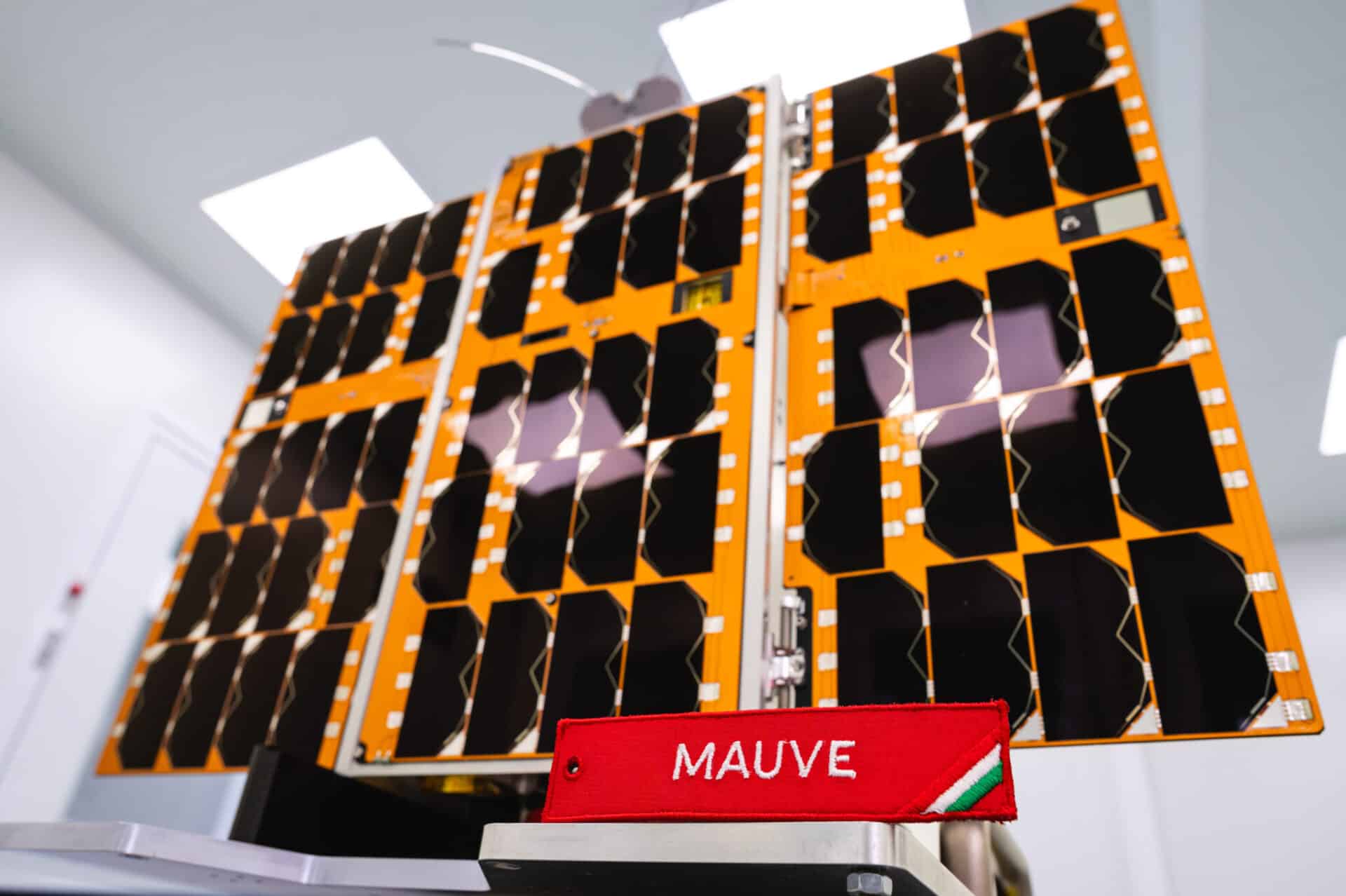
On November 28, 2025, Blue Skies Space launched its first satellite, Mauve, aboard of a SpaceX Falcon 9 rocket as part of the Transporter-15 mission.
Developed by a consortium of European companies and launched within three years of its conception, Mauve is a small scientific satellite weighing just 18.6 kg.
Using UV-visible spectroscopy, Mauve studies stellar activity across the 200-700 nm wavelength range. Its scientific objectives include investigating stellar magnetic activity, energetic flares and how these phenomena may affect the habitability of exoplanets.
Much of the ultraviolet radiation emitted by stars is absorbed by Earth’s atmosphere, making certain wavelengths inaccessible to ground-based telescopes. Operating in a Sun-synchronous orbit approximately 510 km above Earth, Mauve enables researchers to study these emissions through extended and repeated observations of their target stars.
The Role of Avantes Technology in Space Spectroscopy
Mauve’s scientific payload incorporates two standard configuration NEXOS™ spectrometers with CMOS linear-array detection technology, providing a practical example of how compact optical instrumentation can be integrated into space spectroscopy applications.
Incoming starlight is collected by a 13 cm Cassegrain telescope supplied by Media Lario and guided through optical fibers from CeramOptec to the spectrometers, where it is measured and converted into spectral data for analysis.
As Mauve’s research focuses on changes in stellar activity over time, the consistency and reproducibility of these measurements are particularly important.
How Avantes Compact Spectroscopy Supports Scientific Research in Space
Part of the Avantes CompactLine, the AvaSpec-NEXOS™ is a compact, lightweight and versatile spectrometer developed with system integration in mind. It combines the advantages of compact spectroscopy with the optical performance and flexibility required for a wide range of scientific and industrial applications.2
Measuring just 105 × 80 × 20 mm and weighing 277.5 grams in its standard commercial configuration, the NEXOS offers high-speed spectral acquisition, low stray light, and a high signal-to-noise ratio within a small form factor.
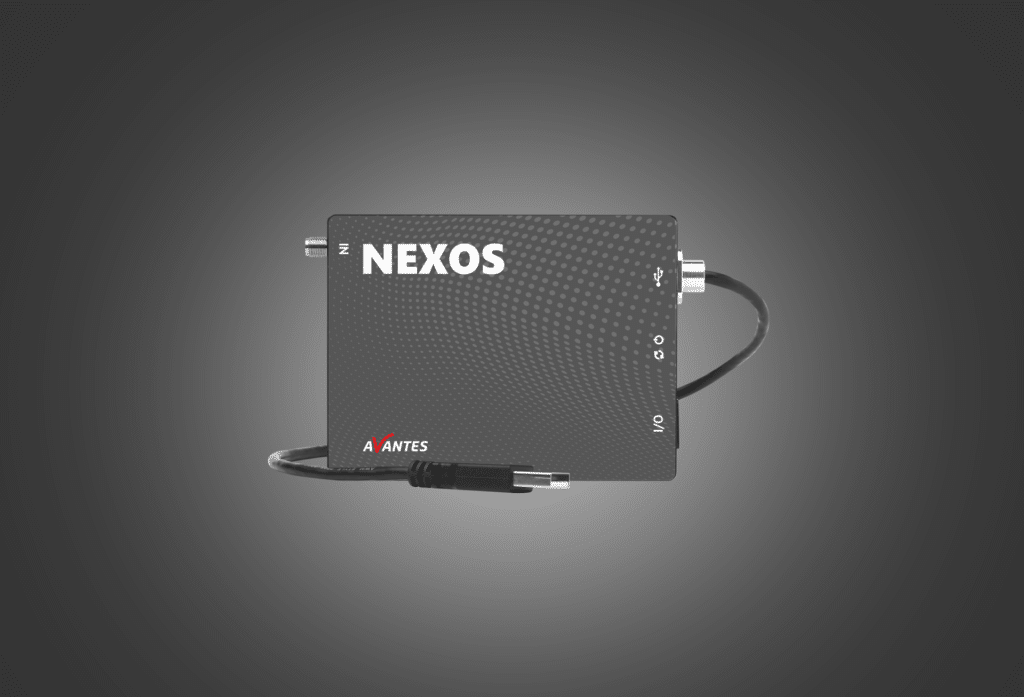
For satellite missions such as Mauve, where the available space and weight allowance for scientific instrumentation are limited, the size and weight of optical components are important considerations alongside their measurement performance.
The integration of two standard configuration NEXOS™ aboard Mauve illustrates how compact spectroscopy technology can be incorporated into specialized scientific instrumentation with demanding system integration requirements.
These advantages are equally relevant to applications on Earth. With configurable optical components, detector options, and flexible integration capabilities, the NEXOS can be adapted to a wide range of measurement requirements, from scientific research and laboratory instrumentation to industrial monitoring and OEM applications.
Learn more about the AvaSpec-NEXOS™ spectrometer and its technical specifications.
The Technical Challenges of Spectroscopy in Space
Operating optical instrumentation in space presents several challenges that differ considerably from those encountered in conventional laboratory and industrial environments.
The scientific instrument must withstand vibrations and shocks during launch, operate in a vacuum, and cope with temperature variations and radiation exposure throughout the mission. Maintaining measurement stability over several years without the possibility of routine maintenance is another important consideration.
Following the successful launch and initial contact with the satellite, Mauve entered its commissioning phase. During this period, the spacecraft’s subsystems and scientific instruments were gradually activated and tested.
For the spectrometer system, this included assessing temperature stability, detector operation, and the optical connection between the telescope, fibres, and spectrometers.
The accuracy of the satellite’s pointing system is also essential, as even small deviations when observing a star can result in light losses and variations in the measured spectrum.
Mauve Captures Its First Stellar Spectrum
On February 9, 2026, Mauve achieved what is known in astronomy as first light, successfully recording its first stellar spectrum.
The satellite was directed toward Eta Ursae Majoris (η UMa), a hot, blue-white star in the constellation Ursa Major, located approximately 104 light-years from Earth. Its strong ultraviolet emission made it a suitable target for the initial observations and calibration of the instrument.
With an integration time of just five seconds, Mauve recorded a spectrum that could be compared with archival observations of the same star from the Hubble Space Telescope.
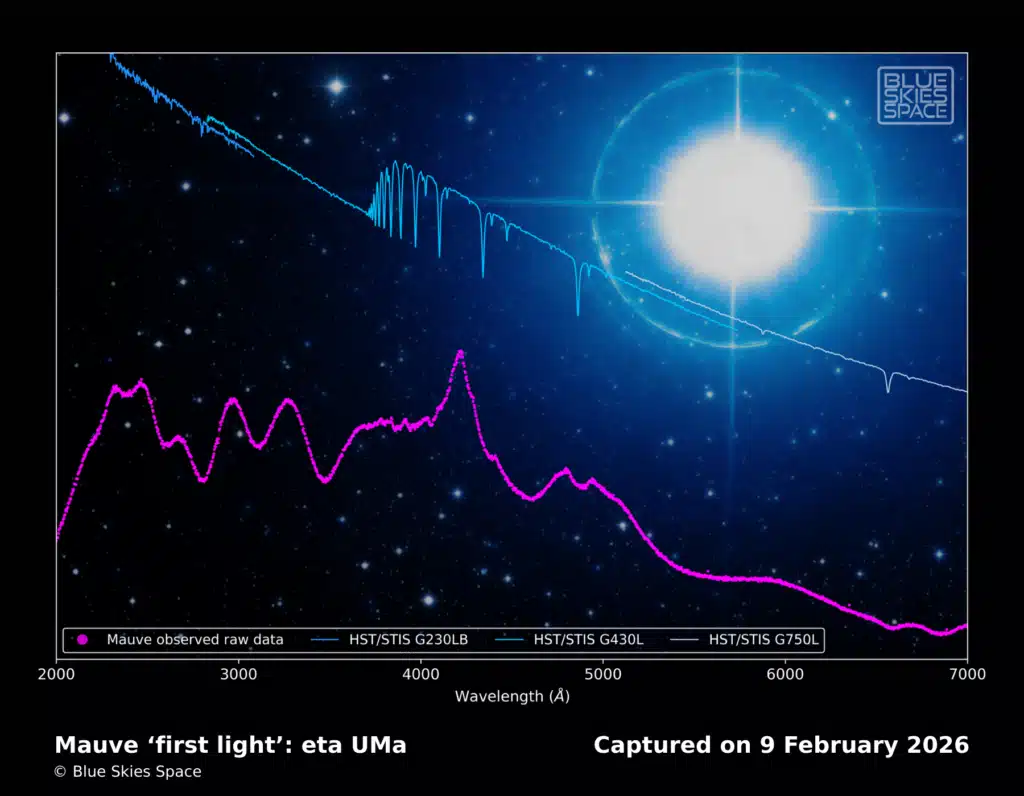
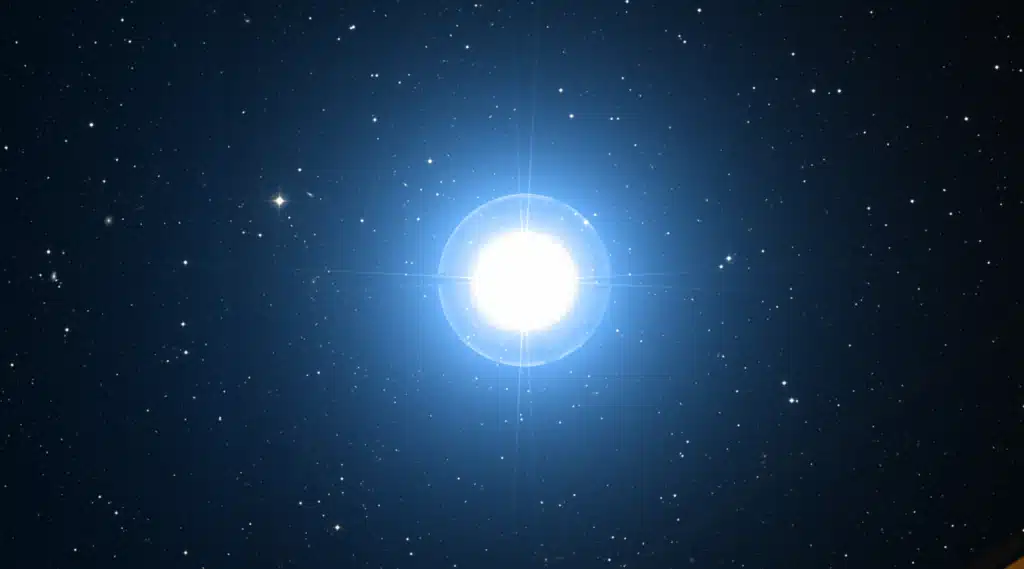
 Image of eta UMa generated using ESA Sky.
Credit: ESA/DSS2 (Digitised Sky Survey).
According to the Avantes technical team, a significant benefit has been the lower-than-anticipated operating temperature of the spectrometers. These lower temperatures have reduced detector noise, contributing to better-than-expected signal quality, which is particularly beneficial when observing fainter stars.
Martijn van de Goor, Application Engineer at Avantes, who has led Avantes’ involvement in the project, adds:
“It is truly remarkable to see a spectrometer perform so well in space. What makes this achievement even more exciting is that the instrument is delivering better performance than originally predicted, thanks to the favorable operating conditions encountered in orbit. Seeing a system not only meet but exceed expectations, while generating valuable scientific data day after day, is incredibly rewarding.”
First Stellar Observations and Scientific Research
Following first light, the Mauve team continued with the calibration and characterization of the scientific instrument, assessing parameters such as wavelength calibration, spectral resolution, detector noise, sensitivity, and measurement stability.
On July 6, 2026, Blue Skies Space announced the delivery of the first datasets to members of the Mauve Science Programme, marking the start of scientific operations.
The program brings together researchers from institutions worldwide, allowing participating scientists to help shape the mission’s research priorities and observation strategies.
Mauve’s scientific program covers several areas of astronomical research, including:
- Stellar activity and flares;
- Hot stars and their evolution;
- Stars hosting young exoplanets;
- Binary star systems.
By observing the same stars over extended periods, researchers can better understand how stellar activity evolves and what impact it may have on surrounding planetary environments. At the center of this research are the spectra collected by the two standard configuration NEXOS ™ spectrometers, providing scientists with the data needed to study these phenomena in greater detail.
Celebrating Mauve’s First Year in Orbit with Avantes Compact Spectrometers
For Avantes, Mauve’s first year in orbit has provided an opportunity to see its compact spectroscopy technology applied in an environment very different from its conventional applications on Earth.
During its first year in orbit, Mauve successfully completed its commissioning, captured its first stellar spectrum, and began delivering scientific data to researchers. For Avantes, it has been particularly rewarding to follow the progress of the two standard configuration NEXOS™ spectrometers as they became operational in space and to see how they are now contributing to scientific research.
With an anticipated mission lifetime of at least three years, Mauve will continue providing researchers with opportunities to study stars and their surrounding planetary environments.
We are proud to be contributing to this mission and look forward to following its scientific findings over the coming years.
To learn more about Mauve, its scientific objectives, and the latest mission developments, visit the Blue Skies Space website.
Future Perspectives for Compact Spectroscopy in Space
For Avantes, the experience gained through Mauve may represent a first step toward a wider range of applications for compact spectroscopy in space. Beyond astronomical research, these could include Earth observation, laser-induced breakdown spectroscopy (LIBS) aboard planetary rovers, and environmental monitoring on the Moon or Mars.
Each of these applications presents its own scientific objectives and technical challenges, and the knowledge gained from operating compact spectrometers in orbit could prove valuable in the development of instrumentation for future space missions.
Why choose Avantes for your application?
- Market leader in developing high-end fibre-optic spectroscopy systems
- Over 30 years of experience and extensive industry and application knowledge
- The best engineers who perform feasibility studies to find the right solution for your application