
Single-channel spectrometers often force a compromise between resolution, sensitivity, and spectral range because all incoming light must be measured through a single optical path and detector configuration. Optimizing the system for higher resolution can reduce the amount of light reaching the detector, lowering sensitivity, while broadening the spectral range may decrease resolution or signal quality. As a result, users are often required to prioritize one performance characteristic over another depending on their application needs.
Dual and multichannel systems overcome these limitations by splitting the spectrum across multiple optimized channels, delivering wide coverage with high resolution and sensitivity in one platform.At Avantes, we take this approach further with a modular architecture designed to eliminate the traditional trade-offs of single-channel spectroscopy. By distributing the workload across multiple optimized channels, researchers gain greater flexibility, performance, and scalability without sacrificing measurement quality.
For laboratories working across diverse applications, from absorbance spectroscopy to plasma analysis, this architecture provides an adaptable platform that evolves alongside experimental demands.
Limits of Single-Channel Spectrometers
In a conventional single-channel system, one optical bench and detector are responsible for the entire wavelength range. To increase spectral resolution, the entrance slit must be narrowed and a higher-dispersion grating is typically used.
This approach has two major consequences:
- Reduced light throughput: A narrow slit limits the amount of light reaching the detector, reducing signal intensity and signal-to-noise ratio.
- Restricted spectral window: Increasing dispersion and resolution reduces the wavelength span that can be captured in a single instrument and results in a reduction of the photon density per pixel thus lower measured signal amplitude..
This leads to familiar trade-offs:
- Higher resolution usually lowers sensitivity.
- Broader wavelength coverage typically sacrifices resolution.
- Improving resolution can decrease acquisition speed and spectral bandwidth.
For low-intensity signals or fast-changing phenomena, these compromises can directly affect data reliability and experimental outcomes.
Multichannel Architecture: A Divide-and-Conquer Strategy
Dual and multichannel spectrometers address these constraints by dividing the optical workload across several channels.
Incoming light is typically split via multi-furcated fiber-optic cables, and each channel is dedicated to a defined wavelength region. Because channels operate in parallel, the system can cover a wide spectral range without asking one detector to resolve everything.
This enables tailored optimization, for example:
- One channel configured for ultraviolet (200-400 nm) performance.
- A second channel focused on high-resolution measurements in the visible region (380-800 nm).
- Additional channels extending into the near-infrared range (780-1100 nm).
Each channel can be tuned for a specific task (grating choice, slit width, detector type, etc.) while still providing simultaneous measurement across the full spectral range of interest.
Maintaining Resolution Across a Broad Spectral Range
Detector resolution is governed by the number of pixels and how they are distributed over the wavelength span. In a single broadband spectrometer, such as one optimized for 200–1,100 nm, every pixel must be shared across that full range. As spectral coverage increases, the number of pixels per nanometer falls, and the ability to resolve closely spaced features decreases.
In a multichannel configuration, the total range is divided into smaller segments, such as:
- 200–400 nm (ultraviolet)
- 400–600 nm (visible, blue–green)
- 600–800 nm (visible, red)
- 800–1,100 nm (near-infrared)
Allocating a narrower wavelength band to each detector increases pixel density per nanometer, resulting in:
- Sharper peaks.
- Improved wavelength accuracy.
- More reliable interpretation of crowded or complex spectra.
- Possibility of optimizing acquisition time (integration time) for a specific wavelength range
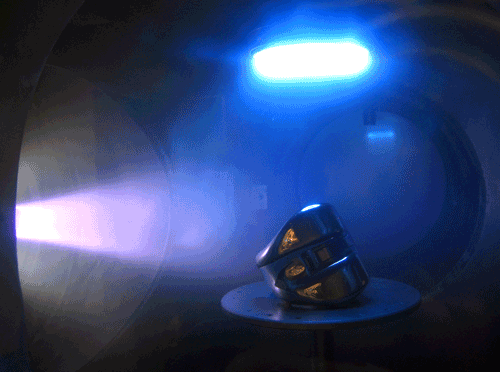
This is particularly advantageous for applications involving dense emission lines or closely spaced absorption bands such a Laser Induced Breakdown Spectroscopy (LIBS) or Optical Emission Spectroscopy (OES).
Synchronized Acquisition for Dynamic Processes
Many optical phenomena evolve rapidly, which places demands on timing as well as spectral coverage. Examples include:
- Plasma optical emission spectroscopy (plasma OES).
- Laser-induced breakdown spectroscopy (LIBS).
- Transient or pulsed light sources.
Multichannel systems support simultaneous triggering of all channels, so every wavelength region is recorded at the same moment. Unlike scanning monochromators, which move through wavelengths sequentially, this configuration captures a full spectrum snapshot in a single acquisition.
Benefits include:
- Accurate temporal correlation across the spectral range.
- Reduced artifacts from source instability or drift.
- Improved comparability of intensity changes at different wavelengths.
For time-resolved measurements, this synchronized acquisition is essential for capturing short-lived or transient events.
Combining Detector Technologies in a Single Platform
A key advantage of modular dual channel and multichannel spectrometers is the ability to integrate different detector technologies within one housing. This allows the system to be tailored to multiple measurement regimes without changing instruments.
Typical combinations can include:
- High-speed complementary metal–oxide–semiconductor (CMOS) channels for routine, rapid measurements.
- Back-thinned charge-coupled device (CCD) detectors for enhanced low-light sensitivity.
- Thermoelectrically cooled detectors to minimize thermal noise and improve signal stability.
- Near-infrared Indium Gallium Arsenide (InGaAs) array detectors to extend coverage beyond the visible region.
Such hybrid configurations enable, for example:
- Simultaneous ultraviolet fluorescence measurements and near-infrared absorption monitoring.
- Radiometric measurements of broad spectrum sources such as solar light.
- Parallel tracking of weak and strong signals within the same experiment.
- Illumination sources can also be integrated into some of the multi-channel configurations such that a spectroscopy appliance is created.
This flexibility supports laboratories that perform varied measurements without needing multiple stand-alone systems.
Scalable System Design for Evolving Requirements
Instrument requirements frequently change over time as projects mature or new analytical questions emerge. Modular multichannel platforms are designed to grow with these needs.
Common housing options include:
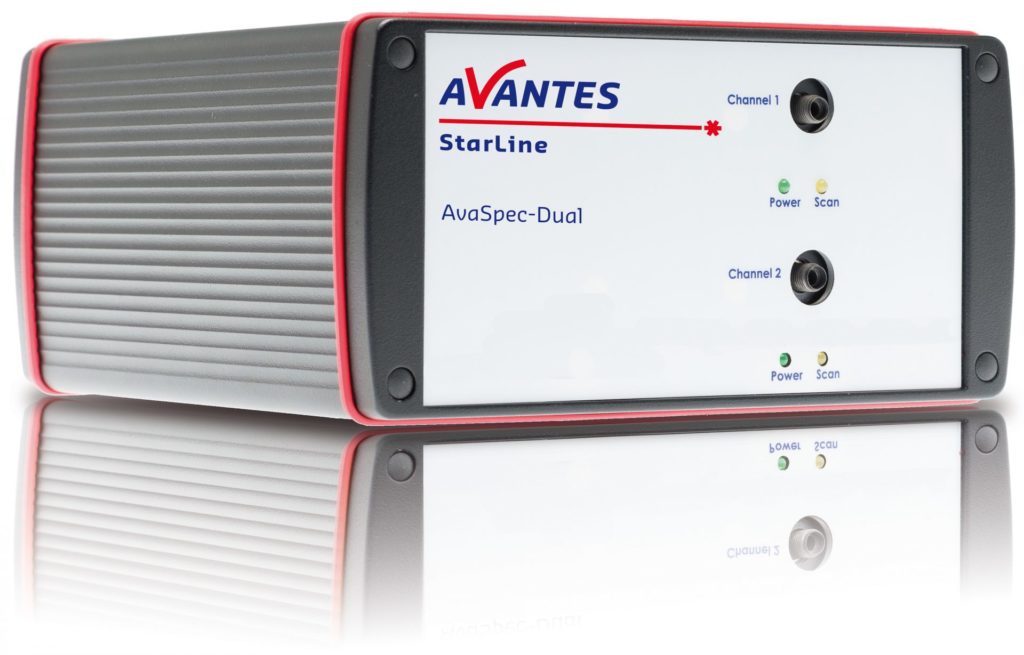
- Compact desktop enclosures with a small number of channels for standard laboratory work.
- Rack-mounted systems for up to 10 channels for research facilities or process monitoring.
This scalable approach offers:
- The ability to start with a minimal configuration and add channels as needed.
- Protection of previous investments by reusing existing modules in expanded systems.
As a result, laboratories can adapt to new methods or sample types without replacing complete systems.
Broad Suitability for General Purpose Spectroscopy
Dual and multichannel spectrometers support a wide range of routine and advanced applications, including:
- Absorbance and transmission measurements in chemical and material analysis.
- Fluorescence and luminescence studies in life sciences and environmental testing.
- Plasma OES and LIBS for qualitative and quantitative elemental analysis.
- Broadband source characterization for radiometric testing.
These applications often combine wide spectral ranges, varying signal intensities, and dynamic behavior. A multichannel platform provides a single, configurable solution that can be adapted to each of these measurement scenarios.
For laboratories handling multiple workflows or shared instrumentation, this versatility simplifies training, maintenance, and experimental setup.
A Valuable Alternative for Modern Spectroscopy
Dual-channel and multichannel spectrometers represent a structural shift in how spectroscopy systems are designed and deployed. By distributing measurement tasks across multiple optimized channels, these systems deliver wide spectral coverage, high resolution, and good sensitivity within a single integrated platform.
For general purpose spectroscopy, the benefit is straightforward: laboratories gain a system capable of adapting to diverse analytical challenges without repeated hardware trade-offs.
At Avantes, this philosophy reflects a commitment to providing instrumentation that supports both present experiments and future discovery. When flexibility, precision, and scalability are required in equal measure, multichannel spectroscopy offers a reliable path forward.